

Understanding ASCII to Binary Conversion and Tables
Explore ASCII encoding and learn how to convert characters to binary with easy reference tables 📊. Perfect guide for computing enthusiasts in Pakistan 🇵🇰.
Edited By
Henry Walker
Understanding how to convert binary numbers to decimal is essential, especially for professionals working with data, finance, or technology. Binary, the language of computers, uses only two digits – 0 and 1. Converting these into decimal numbers, which we use daily, helps in interpreting data and calculations efficiently.
Binary numbers represent values in powers of two. For example, the binary number 101 means:
1 × 2² = 4
0 × 2¹ = 0
1 × 2⁰ = 1
Adding these gives 4 + 0 + 1 = 5 in decimal.
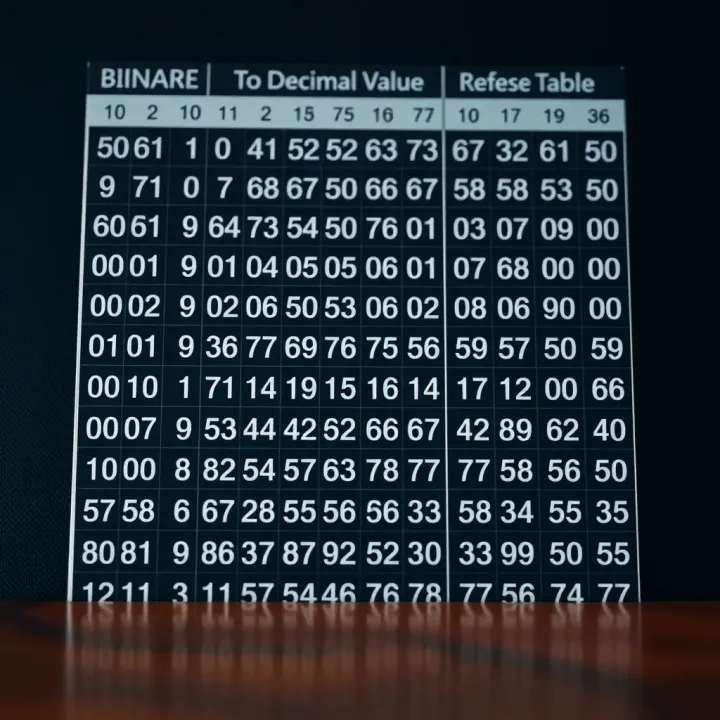
Reference tables simplify this process, especially for longer binary strings. These tables list the binary place values alongside their decimal equivalents, allowing quick conversion without manually calculating powers each time.
In Pakistan's growing tech-based financial market, understanding binary numbers is more than academic. Many trading platforms, crypto exchanges, and algorithmic tools rely on binary-coded data. Being able to translate this into decimals aids in analysing transaction histories, verifying data integrity, or troubleshooting digital tools.
A typical binary to decimal reference table includes:
Binary place values (1, 2, 4, 8, 16, 32, 64, etc.)
Corresponding decimal values
To convert, follow these steps:
Write the binary number and align it with the table's place values
Mark all places where there is a one (1)
Add up the decimal values corresponding to these ones
This method reduces errors, saves time, and helps build confidence with data handling.
Familiarity with binary to decimal conversion improves your ability to work with digital financial tools and enhances decision-making accuracy.
Mastering this skill will offer a practical edge, whether you're reading machine-generated reports or verifying crypto transactions. The coming sections will provide detailed tables and clear examples relevant to your everyday work.
For traders, investors, and financial analysts, understanding the binary number system might seem unrelated to daily tasks, yet it underpins many technologies critical to modern markets. Binary is fundamental to computing, which powers everything from online trading platforms to automated analytics. Grasping the basics of binary can help professionals better appreciate how digital data and encryption work.
Binary is a numbering system that uses only two digits: 0 and 1. Unlike the familiar decimal system, which uses ten digits from 0 to 9, binary's simplicity suits digital electronics and computing devices. Each binary digit, or bit, represents an on/off state, much like a switch. For example, the binary number 1010 corresponds to the decimal number 10. This system forms the basis of all computers and communication technologies, including stock exchange data transmission and crypto currency operations in Pakistan.
Every digit in a binary number has a place value based on powers of two, starting from the rightmost digit which is 2⁰ (one). Moving left, the place values double: 2¹ (two), 2² (four), 2³ (eight), and so forth. For instance, the binary number 1101 breaks down as:
1 × 2³ (8)
1 × 2² (4)
0 × 2¹ (0)
1 × 2⁰ (1)
Adding these gives 8 + 4 + 0 + 1 = 13 in decimal. This place value method lets us convert any binary number to decimal by summing powers of two for each '1' bit.
While the decimal system uses base 10, binary uses base 2. The decimal system counts from 0 to 9 before adding a new digit, but binary flips between 0 and 1. This difference means binary numbers tend to be longer but simpler for electronic circuits to process. For example, the decimal number 15 is represented as 1111 in binary.
Financial software in Pakistan often translates data into binary signals internally, although users see decimal figures. Appreciating how binary underlies these systems can give a clearer idea about data accuracy and speed when analysing market movements or digital transactions.
Knowing the basics of binary and its place values is the first step towards mastering binary to decimal conversion, which itself is critical for understanding computer-generated data in financial analysis and trading.

In the next section, we'll explore how to convert binary numbers into decimal using practical tables designed to simplify this process. This will solidify your understanding and equip you to use digital tools more effectively.
Understanding how binary to decimal conversion works is essential for anyone dealing with digital systems or financial tech in Pakistan. Binary, the base-2 numbering system, is the backbone of computing, while decimal (base-10) is the common language used in daily life and financial transactions. Grasping the conversion process helps traders, investors, and analysts make sense of raw digital data, ensuring clearer insights into technology-driven financial platforms.
In binary systems, each digit (bit) represents a power of two, starting from the rightmost bit, which is 2⁰. Unlike the decimal system where each place value increases by powers of ten, binary place values double as you move left. For example, the binary number 1011 corresponds to:
Rightmost bit (1): 2⁰ = 1
Next bit (1): 2¹ = 2
Next bit (0): 2² = 4
Leftmost bit (1): 2³ = 8
Each bit's value depends on whether it is set to 1 or 0. This setup means binary numbers use fewer digits to represent larger values digitally, but require conversion for human-readable contexts like stock prices or investment calculations.
Converting binary to decimal involves adding the values of bits set to 1. Here's a simple approach:
Write down the binary number: Suppose you want to convert 11010.
List the place values from right to left: 2⁰, 2¹, 2², 2³, 2⁴ → 1, 2, 4, 8, 16.
Identify bits set to 1: In this case, the bits are 1 (at 2⁴), 1 (at 2³), 0, 1 (at 2¹), 0.
Add the corresponding powers of two: 16 + 8 + 0 + 2 + 0 = 26.
Hence, 11010 in binary equals 26 in decimal.
Remember, this method helps analyse digital data streams that financial platforms might generate, helping investors understand behind-the-scenes computations.
This straightforward approach ensures accurate conversion, a skill useful for anyone handling digital financial reports, trading algorithms, or crypto transactions relying on binary calculations. Mastery over this process also aids in debugging software or verifying data integrity.
By focusing on place values and methodical addition, you can efficiently make binary data meaningful in your financial assessments and technology interfaces.
Using binary to decimal conversion tables can greatly simplify the process for traders, financial analysts, and crypto enthusiasts who often deal with data in different formats. These tables provide a quick reference to transform binary strings into their decimal equivalents without performing manual calculations each time. This efficiency matters especially when analysing streams of binary data from financial software, blockchain transactions, or digital indicators.
A binary to decimal table is typically organised with two main columns: the binary number and its decimal equivalent. Alongside, some tables may include place values or powers of two, which help explain the conversion process. For example, the binary number 1010 corresponds to decimal 10, and the table visually connects each bit’s position with its decimal value, such as:
Binary: 1010
Place Values: 8, 4, 2, 1
Decimal: 10
This clear layout helps users understand not only the conversion result but also the reasoning behind it.
When reading the table, start by locating the binary number you want to convert. Pay attention to how the table aligns the bits and their place values. Each bit represents a power of two, beginning with 20 on the right. Add the place values where the bit is 1, ignoring zeros. For instance, binary 1101 corresponds to decimal 13, calculated as 8 + 4 + 0 + 1.
Remember that the position of each binary digit matters. Misreading the sequence leads to wrong decimal values, which can affect decision-making, especially in trading algorithms or crypto wallet addresses.
Conversion tables save time by eliminating repetitive calculations. For professionals handling large datasets, this means faster interpretation and less chance of error. Traders analysing binary-coded signals or crypto users checking transaction data can rely on these tables as a reliable quick-check tool.
Besides speed, these tables aid learning by visually connecting binary numbers to their decimal equivalents, deepening users’ numerical intuition. This is valuable in financial markets where binary data might represent flags, status bits, or compressed numerical values needing rapid conversion.
Efficient use of binary to decimal tables contributes to better data handling in Pakistan’s growing IT and financial sectors, where accurate numeric interpretation underpins both technology development and everyday financial operations. With practice, reading these tables becomes second nature, helping professionals across finance and technology fields to work smarter rather than harder.
Practical examples and exercises play a vital role in mastering binary to decimal conversion. They help you not just understand the theory but also apply it in real-world scenarios, which is especially valuable for traders, investors, and financial analysts dealing with data encoding or digital calculations. By working through examples, you reinforce the core concepts and reduce errors when interpreting binary data.
Start with small binary numbers to build a strong foundation. For instance, converting the binary number 1011 to decimal helps familiarise you with place values. Here, the rightmost digit represents 20, and moving left, each digit's value doubles. So, for 1011, the decimal conversion is:
(1 × 2³) + (0 × 2²) + (1 × 2¹) + (1 × 2⁰) = 8 + 0 + 2 + 1 = 11
Practising such basic conversions helps you grasp how each binary bit contributes to the decimal result, which you can then apply with bigger numbers.
Handling longer binary sequences demands more attention to place values and accuracy. Take a binary number like 11010110. Breaking it down stepwise avoids mistakes:
Assign powers of two from right to left (2⁰ to 2⁷).
Multiply each bit by its place value.
Sum all the resulting values.
For the example, the decimal equivalent is 128 + 64 + 16 + 4 + 2 = 214. This skill is useful not just in finance but also in IT sectors or digital electronics, where data sizes often involve longer binary strings.
Even experienced users slip up during conversion. Watch out for these common pitfalls:
Misreading place values: Confusing which bit corresponds to which power of two leads to errors.
Ignoring leading zeros: They might seem irrelevant but are crucial for correct place alignment.
Incorrect addition of place values: Double-check sums to avoid miscalculations.
Mixing up binary and decimal digits: Ensure you don’t treat binary digits as decimal numbers.
Practice consistently with both simple and complex numbers to avoid these mistakes. Using binary to decimal reference tables alongside exercises can make your work more efficient and less error-prone.
By focusing on practical exercises, you gain confidence and speed in converting binary numbers correctly. This ability serves well across several fields in Pakistan, from IT education to financial data analysis, where binary data often underpins digital processes.
Binary to decimal conversion plays a significant role in Pakistan's tech-driven sectors. Understanding this fundamental process offers practical benefits, especially for traders, investors, financial analysts, stockbrokers, and crypto enthusiasts who operate in increasingly digitised environments. Let's explore how this knowledge is applied across various fields.
In Pakistan, computer science education emphasises binary systems as the backbone of computing. Students in universities and colleges learn binary to decimal conversion early to understand how computers store and process data. This knowledge is crucial when programming, debugging, or working with hardware. For instance, software developers often convert binary log data to decimal to simplify troubleshooting, ensuring applications run smoothly on platforms like the Pakistan Stock Exchange (PSX) trading software.
Moreover, IT professionals working in local fintech firms use these skills when designing algorithms for digital transactions through platforms such as JazzCash and Easypaisa. The familiarity with binary conversions helps in optimising data storage and transmission efficiency.
Pakistan's growing telecommunications sector relies heavily on binary data processing. Mobile networks from Jazz, Telenor, and Zong send vast amounts of binary signals that represent voice, text, and internet data. Engineers convert these binaries into decimal values to monitor signal strength, error codes, and network performance.
In digital electronics workshops across engineering universities in Lahore and Karachi, students use binary to decimal tables to design circuits and interpret sensor data. For example, a digital multimeter reading might be displayed in binary form by microcontrollers and needs conversion to decimal for practical use. This understanding directly supports Pakistan's ambitions to expand 4G and 5G connectivity.
Beyond specialised fields, binary to decimal conversion impacts daily life through devices many Pakistanis use. Smartphones, computers, and smart TVs operate on binary logic internally. When you check your mobile data usage or bank transaction history on apps like HBL Mobile or Bank Alfalah's online portal, the backend systems translate binary data into readable decimal figures.
Additionally, users of cryptocurrency platforms find binary conversion skills helpful when dealing with wallet addresses and blockchain data, where binary often underlies hexadecimal representations.
Grasping binary to decimal conversion equips Pakistani tech professionals and enthusiasts with tools to troubleshoot, optimise, and better understand the digital systems integral to finance, communication, and everyday technology.
This skill is practical, saving time and improving accuracy when handling complex digital information, particularly in Pakistan's fast-evolving technology and finance sectors. Keeping a handy binary to decimal conversion table nearby or using digital tools can ease this process significantly.
Explore ASCII encoding and learn how to convert characters to binary with easy reference tables 📊. Perfect guide for computing enthusiasts in Pakistan 🇵🇰.
Learn the step-by-step binary conversion method for switching between decimal & binary. Ideal for anyone keen on digital systems & computing. 🔢💻

Explore binary conversion 🔢, learn how to switch between decimal and binary, with practical examples and uses in computing and digital electronics.

Learn to convert binary numbers to decimal with easy steps and practical examples 🧮. Understand the process and its role in computing and daily life.
Based on 15 reviews