

Understanding Binary Code Translators and Their Role
Explore how binary code translators decode digital data and why they're vital in computing 🔍 Learn about types, uses, challenges & choosing the right tool.
Edited By
Daniel Cook
Grey code is a type of binary numbering system designed to ensure that only one bit changes at a time between successive values. This feature helps reduce errors in digital circuits, especially in data transmission and rotary encoders used in electronics and industrial control systems. For traders and financial analysts dealing with embedded systems in automated trading platforms or hardware for stock exchanges, understanding grey code conversion is practical.
Unlike regular binary, grey code prevents glitches caused by multiple bit changes happening simultaneously. However, most computational tools and software require data in standard binary format for processing. Therefore, converting grey code back to binary is an essential step.
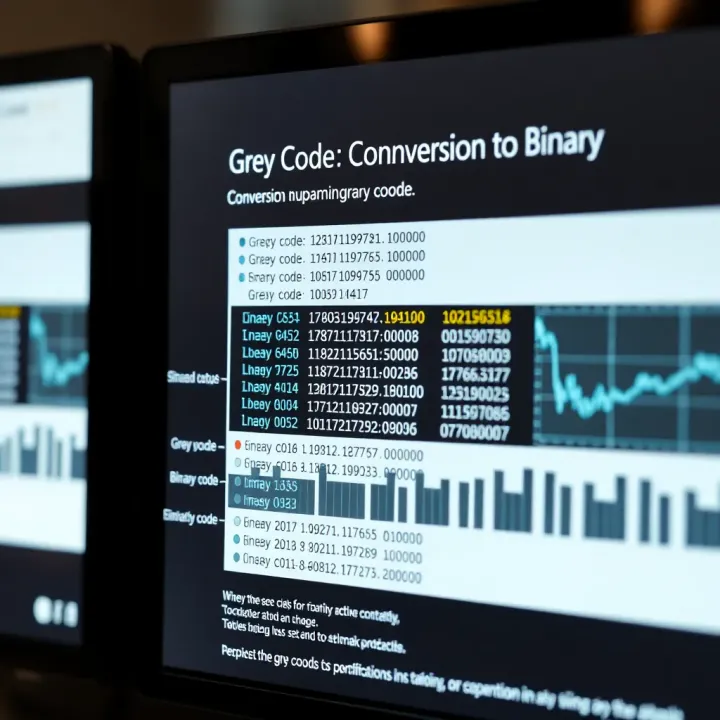
The conversion process uses a simple principle: the most significant bit (MSB) of the binary number remains the same as the grey code. Each subsequent binary bit is found by XOR-ing the previous binary bit with the current grey code bit. This means the binary digits are built bit by bit, comparing with the grey code sequence.
For example, consider the grey code 1101. To convert:
Take the first bit as is: 1.
XOR the first binary bit with the second grey code bit: 1 XOR 1 = 0.
XOR the second binary bit with the third grey code bit: 0 XOR 0 = 0.
XOR the third binary bit with the fourth grey code bit: 0 XOR 1 = 1.
Hence, the binary equivalent is 1001.
Accurate conversion from grey code to binary allows you to interpret sensor data or communicate digital signals correctly, which is crucial in financial systems relying on technology, like algorithmic trading terminals.
Mastering this process helps avoid data errors that could impact decision-making or automated transactions. Understanding grey code also opens up insights into how hardware and digital communication maintain integrity in noisy environments.
Understanding Grey code helps traders, investors, and financial analysts make sense of certain digital signals and hardware interfaces often encountered in market data processing and electronic equipment. Grey code reduces errors during transitions between values, making it a reliable choice for sensors and rotary encoders used in automated trading systems and financial instruments monitoring.
Grey code is a method of representing numbers where each consecutive value differs from the previous by just a single bit. This property limits the chance of error when a signal changes state. Practically, if a system has to read a sequence of numbers during fast data acquisition, using Grey code can prevent mistakes caused by simultaneous bit changes.
Unlike standard binary code, where multiple bits can change between consecutive numbers (for example, from 3 (011) to 4 (100) changes all bits), Grey code changes only one bit at a time. This single-bit change greatly reduces the chance of incorrect readings because fewer bits have to switch simultaneously.
One key advantage of Grey code is its ability to reduce errors during signal transitions. In noisy environments, such as electronic stock tickers or sensor data in manufacturing lines, this property ensures more accurate data collection. When bits change one at a time, the risk of glitches or misreads due to intermediate unstable states drops significantly.
Grey code finds practical use in rotary encoders and position sensors, which are common in automated systems, including those that monitor financial hardware. For instance, position sensors using Grey code can track mechanical shaft rotations with precise increments, ensuring that the readings correspond exactly to the physical position despite mechanical imperfections or electrical noise.
Using Grey code in devices that convert physical movement to digital signals helps maintain accuracy and reduces downtime caused by sensor errors.
These features make Grey code vital in digital communication and industrial automation, indirectly supporting financial infrastructures that depend on reliable sensor data for decision-making.
Understanding how grey code differs from standard binary is essential to grasp why conversion between the two matters. Grey code is designed so that only one bit changes between consecutive values, reducing errors in signal changes. Binary, however, counts in the usual base-2 fashion, where multiple bits can change simultaneously. This fundamental difference affects how devices read and process data, especially in sensitive or noisy environments.
Grey code features a unique property where each successive number differs from the previous one by just a single bit flip. This reduces the chance of errors during the transition between numbers, which is critical in applications like rotary encoders or sensors. For example, when a rotary sensor moves from position 3 (binary 011) to position 4 (binary 100), multiple bits change in binary, but in grey code, only one bit shifts, minimising misreads caused by mechanical imperfections or timing delays.
This property helps maintain signal integrity and reliability. In digital circuits subject to noise or glitches, reducing simultaneous bit changes prevents incorrect readings or erratic behaviour, making grey code particularly useful where stability is vital.
To illustrate, consider counting from 0 to 7. The standard binary sequence is:
000, 001, 010, 011, 100, 101, 110, 111
Here, multiple bits can change between steps. For grey code, the sequence looks like:
000, 001, 011, 010, 110, 111, 101, 100
Notice how only one bit flips with each step. This pattern ensures fewer transition errors in many electronic systems, though it complicates direct numerical reading. Recognising these differences clarifies why conversion to binary is necessary for computational tasks.
Most computing systems and processors inherently understand binary numbers, not grey code. To perform arithmetic or logical operations on grey code inputs, the data must be converted back into binary. Without this step, values read from sensors in grey code would be meaningless to a computer trying to process numerical data.
For instance, a sensor might output the grey code 0101, which needs translating into its binary equivalent before further calculations like speed, position, or distance can be done accurately.
Digital circuits, including microcontrollers and programmable logic devices, operate with binary representation. Grey code simplifies hardware challenges by improving signal stability but does not replace the binary logic cores these devices use. Therefore, reliable grey-to-binary conversion circuits or algorithms are critical to integrate grey code devices into digital systems.
This necessity means engineers must understand both code formats thoroughly to design efficient, dependable systems. Conversion ensures that the stability advantages of grey code are retained, while compatibility with digital logic is maintained.
Recognising the differences between grey and binary codes and why conversion is vital helps in designing systems that balance accuracy with processing efficiency. This knowledge is key for traders and analysts dealing with hardware interfacing in finance-related technologies or automated trading systems, where signal quality can impact reliability.
Together, these insights explain both the practical rationale and the technical need behind understanding grey code's unique representation and the essential step of converting it to binary.
Understanding how to convert grey code into binary is essential, mainly because binary remains the foundation for most digital systems, including trading platforms and automated decision tools used by financial analysts and investors. This conversion step ensures that data represented in grey code—which reduces error in bit transitions—is accurately interpreted for further computation or analysis.
The first rule when converting grey code to binary is to copy over the most significant bit (MSB) directly from the grey code as the initial binary bit. This step is straightforward yet critical because the MSB sets the baseline for all following bits, maintaining the proper scale of the number.
Choosing the MSB as the starting point helps maintain the correct hierarchy of bits in the binary number. It reflects the highest power of two and ensures the result correctly represents the same numeric value as the grey code input. Without correctly assigning the MSB, the whole conversion would be off, leading to wrong values that could misinform trading algorithms or financial analytics.
The exclusive OR (XOR) operation is key to unveiling the binary value for every bit following the MSB. The logic here is that each subsequent binary bit equals the XOR of the preceding binary bit and the current grey code bit. This approach works because grey code changes only one bit at a time, preserving the relationship between bits.
By applying XOR stepwise, each binary bit accounts for the transition encoded in grey. This approach eliminates ambiguity, which is crucial when systems depend on precise data interpretation—imagine a crypto trading bot misreading inputs due to faulty conversion. The stepwise XOR ensures each binary bit logically follows from the previous, providing a solid conversion foundation.
Consider the grey code 1101 as input. This example demonstrates how you can apply the initial bit and XOR operations clearly to reach the binary equivalent.
Start by taking the first grey bit ‘1’ as the MSB of the binary number. Next, compute the second binary bit by XOR-ing this binary MSB (1) with the next grey bit (1), resulting in 0. Proceed with the third bit, XOR-ing the second binary bit (0) with the third grey bit (0), yielding 0. Finally, XOR the third binary bit (0) with the last grey bit (1) to get 1.
The final binary output, therefore, is 1001. This value can then be used confidently in trading software or analytic models requiring binary input. It shows the clarity and accuracy that a correct grey to binary conversion delivers, reducing errors during digitised data transmission or processing.
The key takeaway is that careful initial bit assignment and consistent XOR application form the backbone of accurate grey to binary conversion. For traders and analysts, this method ensures that the data you depend on is reliable and precise, avoiding costly mistakes.
Grey code conversion finds real value beyond theory, especially in fields where precision during state transitions matters. Its unique property of changing only one bit at a time limits errors common in binary counting systems. This makes grey code conversion crucial in various hardware devices and communication protocols.
Grey code is especially useful in rotary encoders, devices that translate mechanical rotation into electrical signals for angle measurement. Traditional binary systems risk multiple bit errors when transitioning between positions, but grey code ensures only one bit flips at a time, reducing misreadings caused by mechanical misalignments or electrical noise.
In practical terms, a rotary encoder using grey code can detect its exact position more reliably, which is vital in industrial settings like CNC machines or robotics. For example, in a manufacturing plant producing automotive parts, precision in motor positioning ensures that assembly robots operate smoothly without costly mistakes.
Moreover, position sensors employing grey code conversion help mitigate errors caused by vibrations or sudden movements. This consistent reading improves the durability and performance of machines under harsh working conditions.
Grey code also plays a role in lessening signal errors during bit transitions in digital communication. When data signals change state, switching only one bit reduces the chance of glitches and faulty readings on the receiving end.
This characteristic is handy in systems where fast, reliable data transfer is key. For instance, satellite communication or wireless sensor networks use grey code to maintain signal integrity despite interference or weak transmission.
In data transmission systems, incorporating grey code conversion helps in encoding address lines or synchronisation signals. This approach decreases the likelihood of bit errors when signals switch, preserving data accuracy and reducing retransmission needs, which saves bandwidth and time.
Using grey code conversion isn't just about counting bits differently—it's about increasing real-world reliability where every single error can mean costly downtime or lost data.
In short, understanding the practical benefits of grey code conversion equips engineers, traders in tech hardware, and analysts to appreciate how such simple logic safeguards complex operations across industries.
Understanding common pitfalls in converting grey code to binary is essential for anyone dealing with digital signals, especially traders and analysts working with hardware that relies on precise data transmission. Mistakes during conversion can lead to incorrect interpretations, affecting the accuracy of sensor readings or digital computations.
One frequent mistake is misplacing bits during conversion. The most significant bit (MSB) of grey code should be carried over directly as the MSB of the binary number. Messing up this alignment leads to errors that ripple through the subsequent bits. For instance, if the second bit is taken from the wrong grey code position, the XOR operations that follow won't yield the correct binary sequence.
This error is especially critical when converting longer grey codes like those found in rotary encoders used for industrial trading equipment. Even a single wrong bit position can result in a completely different binary output, potentially misleading decision-making processes downstream.
The XOR operation is at the heart of converting grey code to binary. A common blunder is not applying XOR in the correct sequence or misunderstanding which bits to XOR at each step. Remember, each binary bit (after the MSB) is obtained by XORing the previous binary bit with the current grey code bit.
For example, starting from the MSB, to find the next binary bit, you XOR the previous binary bit with the next grey code bit. Skipping this step or mixing the bit positions causes faulty conversion. This mistake might go unnoticed without verification, leading to incorrect binary data used in financial hardware or algorithmic trading setups.
A smart way to verify your grey to binary conversion is to reverse the process. Converting your binary result back to grey code should match the original grey code input. This cross-check ensures the conversion logic is intact and free from manual errors.
In financial data sensors or positioning devices, where precision is key, this validation step can save hours of troubleshooting. If discrepancies appear, they typically point back to bit misplacements or XOR misapplication.
Software tools can quickly validate your grey to binary translations. Many microcontroller programming environments or simulation software include functions to convert and verify grey code. Using these tools reduces human error and speeds up the development of systems dependent on grey code.
For tech-savvy traders or analysts integrating hardware with software dashboards, employing these validation tools ensures that the data they rely on is both accurate and reliable, avoiding costly mistakes in real-time operations.
Always double-check your conversions rather than assuming correctness—simple oversights can cause big inaccuracies.
In essence, watching out for bit positioning errors, correctly applying XOR logic, and verifying through reverse conversion or software tools forms a solid approach to mastering grey code to binary conversion. Practising these steps helps maintain data integrity and confidence in systems where grey code is used.
Explore how binary code translators decode digital data and why they're vital in computing 🔍 Learn about types, uses, challenges & choosing the right tool.

🔍 Explore how binary search works with clear code examples, learn about time complexity, edge cases, and practical uses in programming for efficient data search.

💻 Discover how binary code forms the backbone of digital devices! Learn its history, structure & role in coding & data, essential for today's tech world.

Explore binary relations in sets: clear definitions, key properties, and types like equivalence and partial orders 🔍 Ideal for those with basic set theory knowledge.
Based on 11 reviews