
Understanding the Binary Number System Guide
🔢 Learn the binary number system with this practical guide! Understand binary basics, conversions, arithmetic, and how to make a handy PDF for easy learning.
Edited By
Charlotte Mitchell
When diving into the nuts and bolts of computing and digital data, the way numbers are represented beneath the surface is fundamental. One of these fundamentals is understanding how decimal numbers, like 65, translate into binary—a system based only on zeros and ones. For traders, investors, and financial analysts dealing with high-speed computing and algorithmic trading, knowing the binary basics can add a surprising layer of insight into how computers process information fast and efficiently.
Binary numbers aren’t just a technical curiosity; they’re the backbone of all digital computing. Everything from storing stock prices in financial software to running complex crypto trading algorithms depends on them. This article breaks down how the number 65 is represented in binary, walking through the conversion process step-by-step, and showing why these simple sequences of bits pack a heavyweight punch.
Understanding binary representation isn’t about becoming a computer scientist overnight—it's about grasping how everyday tech around finance fundamentally works at its core.
Here’s what you can expect:
Basics of binary numbering: What is binary, and how does it differ from the decimal system?
Conversion techniques: How to manually convert decimal numbers like 65 into binary formats, with examples.
Practical use cases: Why knowing this matters for fields like finance, crypto trading, and data analysis.
Tools and tips: Easy ways to convert numbers without breaking a sweat.
By digging into this, you’ll not only sharpen your number sense but also appreciate the language that powers financial tech running behind the scenes.
Understanding the basics of the binary number system is essential, especially when dealing with numbers like 65 and their digital representations. Binary is the foundation on which modern computing is built, making it highly relevant for traders, investors, and financial analysts who rely on technology and software for data analysis and decision-making.
At its core, the binary system is a way to express numbers using only two digits, 0 and 1. This simplicity allows computers to process and store vast amounts of data efficiently. Knowing the fundamentals helps in grasping how digital devices work behind the scenes—and why numbers, whether simple like 10 or more specific like 65, take certain forms in programming and electronics.
By understanding binary basics, one can appreciate how complex financial modeling software, blockchain technology, or stock market algorithms translate commands and values at the most basic level. This knowledge doesn't just stay theoretical; it informs better software use and troubleshooting, data interpretation, and even security comprehension.
Binary is a numbering scheme that uses only two symbols: 0 and 1. Unlike the decimal system, which is base 10, binary is base 2. Each digit in a binary number is called a “bit,” and it's the smallest unit of data in computing. This makes binary suited for devices that handle two states, such as on/off or true/false.
For instance, in binary, the decimal number 3 is written as 11, because it’s 1×2^1 plus 1×2^0. This simple structure makes it easier for hardware, like processors and memory modules, to handle numeric data.
Digital devices, from smartphones to stock trading platforms, operate using binary signals. These devices interpret electrical signals as either high (1) or low (0) voltage, making binary ideal for machine language.
Consider a trader using a computer platform; the commands and data entered are translated into billions of bits, which the processor promptly deciphers into meaningful actions—like fetching stock prices or executing trades. Without binary, such seamless digital communication would be impossible.
The decimal system uses ten digits (0-9), reflecting how humans naturally count. Binary, however, only uses two digits but can represent any decimal number by combining bits.
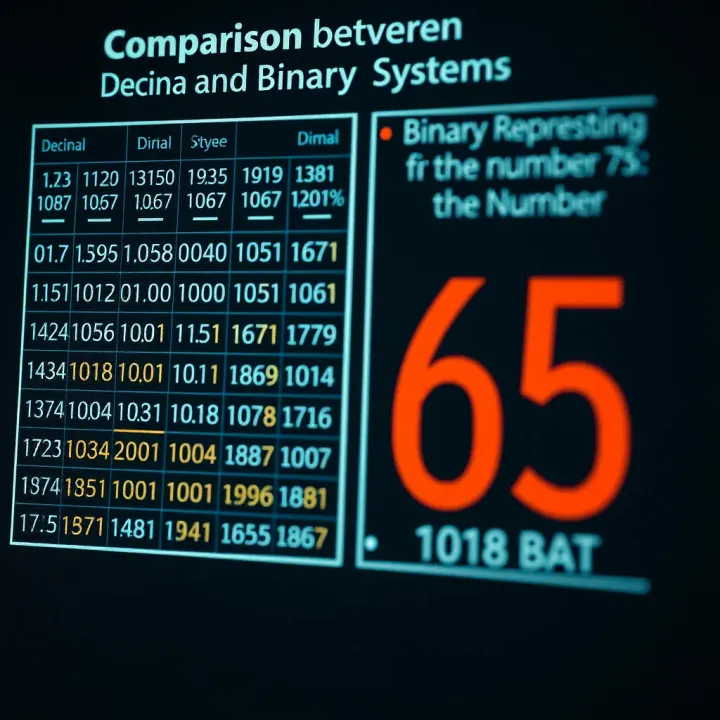
While decimal numbers feel more intuitive, binary is much more efficient for electronic devices. For example, the decimal number 65 is represented as 1000001 in binary. Although it looks longer, binary aligns directly with digital circuits' on/off states, making processing faster and more reliable.
A bit represents a binary digit—either 0 or 1. Though just a simple value, bits combine to form more complex data. For example, eight bits (known as a byte) can represent numbers from 0 to 255, which covers a wide range used in digital settings.
Each bit carries weight depending on its position in the number, influencing the number's overall value. Recognizing bit significance is crucial when working with low-level data operations or troubleshooting computer behavior.
Much like the decimal system, binary assigns place values based on powers—specifically powers of 2. The rightmost bit represents 2^0 (which equals 1), the next one 2^1 (equals 2), then 2^2 (equals 4), and so forth.
This gives the binary number 1000001 its worth: the first and last bits are set to 1, meaning 2^6 (64) plus 2^0 (1), which sums up to 65.
To contextualize, here are a few decimal to binary conversions:
Decimal 2 = Binary 10
Decimal 5 = Binary 101
Decimal 10 = Binary 1010
Seeing such patterns helps make sense of binary’s structure. For anyone working with digital systems—be it in finance programs or automated trading platforms—this understanding forms a practical foundation.
"Binary numbers might look strange at first, but they’re simply the language of modern tech—grasping them is like learning to read a whole new alphabet."
Knowing how binary works and why it’s used sets you on confident footing to tackle further topics, like converting numbers such as 65 into binary, verifying those conversions, and applying this in real-world technology.
Understanding the decimal number 65 is a key step before we jump into its binary form. Decimal numbers are what most of us use daily — from counting money to calculating investment returns. Grasping the ins and outs of how 65 works in decimal gives a solid foundation to decode its binary counterpart correctly.
The decimal system, also called base-10, is the numbering method we use every day. It’s built on ten digits: 0 through 9. Each digit's position tells you how much it’s worth – those positions are powers of 10, starting with the ones place, then tens, hundreds, and so forth. This explains why the number 65 means 6 tens plus 5 ones, or 60 + 5.
Recognizing how value stacks with place matters if you want to see why certain digits in binary are 1 or 0 — those bits hold place values too but using base-2 instead of base-10.
Think about when you’re looking at stock prices or crypto values. You don’t just see ‘65’, you see it breaking down into parts you can add easily. This same logic applies universally, from simple counting to how computers handle numbers under the hood.
Each digit in a decimal number has a value based on where it sits. For 65, the "6" occupies the tens place, so it counts as sixty, while “5” is in the ones spot, meaning it counts as five. In financial terms, this is like seeing a price as $65 — the tens and ones dictate the value you pay.
This place value system means every digit's position changes what the number means overall. When converting decimal 65 into binary, this positional value helps us understand how and why the decimal breaks down into different bits.
To see decimal in action, imagine checking your bank statement. If your balance is 65, say 65 Pakistani Rupees, that means six groups of ten rupees and five individual rupees. Similarly, if a share price is 65 PKR, investors understand not just the number but its value comprised of tens and singles. Ordinary math you do daily with decimals creates the framework for more complex calculations in trading or programming.
Let’s look beyond the math to why 65 specifically catches attention. It pops up in real-world contexts and has some interesting mathematical traits.
Sixty-five shows up in all sorts of places. In many countries, 65 is the typical retirement age—a big milestone for planning finances. In technology, ASCII code 65 represents the letter ‘A’, tying number systems directly to computer text and communications.
For traders or crypto enthusiasts, 65 might represent an asset price or a threshold to watch. Understanding it well can help with interpreting data feeds or setting precise points in analysis.
Mathematically, 65 is not just any number. It’s a product of two primes, 5 and 13, which means it’s composite but breaks down neatly — useful in various algorithms and encryption systems. It’s also part of some interesting number pairs, like being the sum of two squares: 64 + 1. This plays a role in coding and encryption techniques, an area closely tied to digital trading platforms and financial systems.
Tip: Knowing 65’s role both in everyday life and specialized math helps investors see why numbers matter, beyond just digits on a screen.
Understanding these decimal foundations enriches how you approach the binary version of 65, especially in fields like trading and finance where precision counts.
Converting the decimal number 65 into binary is a key step to understand its digital representation—something every trader or crypto enthusiast should grasp. Since computers use binary to process and store data, knowing how this conversion works lets you peek behind the curtain at what’s really happening under the hood. It’s not just academic; when dealing with cryptographic algorithms, transactions, or even low-level data manipulation, binary understanding gives you an edge. The conversion shows how decimal numbers break down into bits—zeros and ones—that machines read, allowing you to work with digital systems more confidently.
The most straightforward way to convert 65 to binary is by repeatedly dividing by 2 and noting down the remainders. Here’s how it goes: take the number (65), divide by 2, then write down the remainder (which will be 0 or 1). Next, use the quotient and repeat the process until you reach zero. This method is practical because it taps into the very nature of binary – two possible states.
Example in action:
65 ÷ 2 = 32 remainder 1
32 ÷ 2 = 16 remainder 0
16 ÷ 2 = 8 remainder 0
8 ÷ 2 = 4 remainder 0
4 ÷ 2 = 2 remainder 0
2 ÷ 2 = 1 remainder 0
1 ÷ 2 = 0 remainder 1
This tells you that the binary digits will be the remainders read from bottom to top.
The remainders you jot down in each division step are the actual binary digits (bits). Tracking these carefully is crucial—if you miss or mix the order, the binary number you get will be wrong. Remember, the last quotient before reaching zero corresponds to the highest value bit.
Keeping tabs on remainders is like marking spots on a treasure map; the order matters just as much as the marks themselves.
By recording the remainders exactly as they come, from last to first, you reconstruct the binary equivalent correctly.
After collecting the remainders, you simply read them from bottom to top. For 65, reading the remainders upwards gives you 1000001. This binary number represents 65 in base-2.
Constructing the binary number is more than putting digits side by side; it’s about understanding how the place values add up:
The far right bit is the least significant bit (LSB), representing 1.
Each step left is a power of two (2, 4, 8, 16, 32, 64)
By combining these, the binary digits translate back to the decimal number 65. This construction technique builds the bridge between two numbering cultures, crucial for anyone dealing with computer data or crypto transactions.
Once you have your binary number, verifying it by converting back to decimal ensures accuracy. To translate 1000001 back to decimal:
Start from right to left, multiply each bit by 2 raised to its position index starting from 0.
For 1000001:
(1 × 2^6) + (0 × 2^5) + (0 × 2^4) + (0 × 2^3) + (0 × 2^2) + (0 × 2^1) + (1 × 2^0)
64 + 0 + 0 + 0 + 0 + 0 + 1 = 65
This confirms our binary number represents 65 exactly, nailing down the link between decimal and binary.
To avoid mistakes:
Double-check the remainders during division.
Ensure the binary digits are ordered correctly — the most significant bit (MSB) on the left.
Use simple verification like converting the binary back to decimal.
Mistakes here might cause downstream errors, whether you’re debugging code or analyzing financial data signals. Accuracy is especially important in crypto where tiny errors can mean big losses.
Taking just a few minutes to verify your binary conversions protects from headaches later—trust me, it’s worth the fuss.
By following these steps systematically, converting and verifying binary numbers like 65 becomes a reliable skill, helping you better engage with digital systems and the technology that’s significant in finance, trading, and crypto environments.
Understanding how the number 65 is represented in binary form goes beyond just an academic exercise. For anyone working with digital systems or even dabbling in programming, grasping the nitty-gritty of binary numbers is essential. The binary form of 65 acts as a practical example that illustrates how data is processed and stored in computers and electronic devices. When you look at 65 in binary, it’s not just a jumble of zeros and ones; it reveals how machines comprehend and work with numbers internally.
Breaking down the binary representation helps demystify the way computers store numeric information, making it clearer how bits come together to form meaningful data. This detailed approach is particularly beneficial for investors or traders who develop or use software for real-time market analysis—understanding how numbers are stored can influence algorithm efficiency and data accuracy.
The choice of 8 bits, or one byte, is fundamental in digital systems. It’s kind of like a standard ‘word length’ for many microprocessors and computing units. Using 8 bits to represent 65 ensures consistency and compatibility across different hardware and software platforms. Think of it as a fixed-size mailbox where each piece of mail fits perfectly; too large or too small, and things get confusing.
In this format, 8 bits provide 256 unique combinations (from 0 to 255), more than enough to represent 65 comfortably. For financial analysts who handle different ranges of data, understanding these limits is key when designing or choosing software tools that rely on binary data.
When representing 65 in an 8-bit binary format, it’s written as 01000001. The ‘leading zeros’ here aren’t just filler; they ensure the number fits neatly into the 8-bit structure. This padding is crucial because omitting these zeros might cause misinterpretations, especially when binary data interacts with other layers of software or hardware.
In practical terms, leading zeros help maintain alignment, keep data structured, and simplify debugging processes when you’re working with binary streams. Traders working with high-frequency trading algorithms often find that even a small glitch caused by misaligned binary data can lead to significant errors.
Visually, 65 in binary looks like this:
plaintext 0 1 0 0 0 0 0 1
Each digit represents a bit, with the leftmost bit as the most significant bit (MSB) and the rightmost bit as the least significant bit (LSB). Visualizing it this way helps in quickly identifying which bits are set (1) and which aren’t (0). For example, the binary here has 1s at the second and the last bit positions, helping to decode or troubleshoot the binary number more intuitively.

### Binary Breakdown of Each Bit

#### Value of each bit position

Each position in an 8-bit binary number corresponds to a power of 2, starting from 2^7 at the left (MSB) to 2^0 at the right (LSB). It’s like a lineup where each position tells you how much that bit contributes, if it’s ‘on’. The positions and their values are:

- Bit 7: 128 (2^7)
- Bit 6: 64  (2^6)
- Bit 5: 32  (2^5)
- Bit 4: 16  (2^4)
- Bit 3: 8   (2^3)
- Bit 2: 4   (2^2)
- Bit 1: 2   (2^1)
- Bit 0: 1   (2^0)

Knowing these helps in converting binary back to decimal by summing only the bit values where the bit is 1.

## Which bits are set for

For 65, the bits set to 1 are bit 6 (64) and bit 0 (1). Adding these values gives 64 + 1 = 65, which confirms the value of the original decimal number.

This kind of breakdown is very handy when you’re debugging binary data or writing programs that manipulate bits directly, such as when flags or switches are involved. For instance, a crypto trading bot might use specific bits as flags to represent different trading signals.

#### Interpreting the binary

Interpreting 8-bit binary numbers like 65 requires understanding both the positional value and the overall context. It’s not just about which bits are 1s or 0s, but how these relate to operations, logic flows, or data storage in real applications.

For those involved in financial analytics, a solid grasp on bitwise operations—enabled by interpreting these bits correctly—can lead to more efficient data encoding and processing strategies. It might seem small, but accurately decoding and using binary representations can shave off milliseconds in high-speed trading environments or cryptographic computations.

> Remember, binary is the language computers use to breathe life into numbers. Grasping the nuts and bolts of numbers like 65 in binary gives you a peek behind the curtain of how digital systems really tick.

## Practical Uses of Binary Numbers Like

Binary numbers like 65 are not just academic curiosities—they play a key role in the technology we rely on every day. Learning how binary forms represent numbers helps traders, investors, and financial analysts understand how data is managed, stored, and processed in digital systems. For example, when stock prices are transmitted or stored within financial software, those decimal prices are converted into binary for efficient computation.

In practical terms, seeing how 65 translates to binary offers a window into the nuts and bolts of computing devices and programming languages. This knowledge can deepen your understanding of the technology underlying financial algorithms, crypto systems, and market data feeds.

### Binary in Digital Electronics

#### Role in microprocessors

Microprocessors are the brains behind everything from your laptop to automated trading platforms. They operate using binary code, processing instructions encoded as sequences of 0s and 1s. Each binary value, like the number 65 (which in binary is 01000001), corresponds to specific commands or data points.

For example, in a microprocessor, the binary 01000001 might represent the command to load a particular piece of data or perform an arithmetic operation. This makes binary numbers the foundation for how microprocessors interpret and execute instructions quickly and accurately.

Understanding this connection is helpful because it shows how seemingly abstract binary numbers translate directly into real-world computing actions, including the financial calculations or algorithmic trading decisions traders rely upon.

#### Binary signals and switches

Under the hood, digital devices use binary signals to control electronic switches — either turning a circuit on (1) or off (0). Think of it like a light switch; it’s either up or down, no in-between. This binary system is essential to how computers process information reliably.

For instance, when a digital communications device sends data, it represents that data with pulses of electricity turned on and off rapidly—each pulse corresponding to a 1 or 0 in binary form. It’s like Morse code but electronic.

This simplicity allows for fast and reliable data transmission, essential for ensuring market data and trading commands reach their destinations without error.

### Binary in Computer Programming

#### Representing characters and data

Binary numbers are the backbone of how computers represent everything, including characters and complex data structures. The number 65 in binary, for example, corresponds to the ASCII character 'A'.

In programming, when you want to display ‘A’ on screen or process it, your software uses the binary value 01000001 to represent it. This goes for letters, numbers, symbols—each has a binary equivalent. This binary representation allows computers to handle text and data in a consistent way, which is crucial in financial software that processes streams of information and commands.

Understanding this can help you grasp why data formats and encoding standards are vital in software development, including apps that traders and analysts use daily.

#### Memory addressing

Memory in computers is organized so that every byte has an address, and these addresses themselves are expressed in binary. When dealing with numbers like 65, you need to understand how binary system helps position or locate data within the computer's memory.

For example, a piece of data stored at memory address 65 means the computer looks up the binary equivalent (01000001) to fetch or store information. This system lets programs access the exact data they need quickly.

For traders or developers writing scripts in financial analysis, knowing how memory addressing works can clarify how data is accessed and manipulated behind the scenes. This groundwork improves debugging skills and understanding of software performance.

> Binary numbers aren’t just zeros and ones—they form the essential language that digital technology speaks. Whether it’s processing instructions in a microprocessor or representing text and data in software, binary like the number 65 is fundamental to the tech world that supports financial markets.

By grasping these practical uses, you gain insight into the digital mechanics powering the tools and platforms around you.

## Tools and Methods to Convert Numbers to Binary

When you're dealing with numbers like 65 and want to convert them to binary, having the right tools and knowing the best methods makes all the difference. This section highlights practical ways to convert decimal numbers to binary, showing you how to do it manually and digitally. Whether you’re deep into trading systems or just dabbling in crypto analytics, knowing reliable conversion methods is a neat skill that keeps you sharp and accurate.

### Manual Calculation Techniques

Manual methods are a great way to really understand what’s going on behind the scenes. You get hands-on with the number and see how the binary system builds up digit by digit.

#### Long division method

The long division method is a traditional way of converting a decimal number, like 65, to binary. You repeatedly divide the number by 2 and track the remainders. Each remainder is a bit, starting from the least significant bit (rightmost). For 65, dividing by 2 gives a remainder of 1, then continue dividing the quotient until you reach zero. Writing the remainders bottom to top produces the binary number. This method is straightforward but requires careful tracking to avoid mistakes.

For example, following this for 65:

- 65 ÷ 2 = 32 remainder 1
- 32 ÷ 2 = 16 remainder 0
- 16 ÷ 2 = 8 remainder 0
- 8 ÷ 2 = 4 remainder 0
- 4 ÷ 2 = 2 remainder 0
- 2 ÷ 2 = 1 remainder 0
- 1 ÷ 2 = 0 remainder 1

Read bottom remainders upwards: 1000001.

Learning this method helps traders or analysts appreciate how data moves through a system without relying completely on software.

#### Doubling method

Alternatively, the doubling method flips the process and can sometimes be easier when converting binary back to decimal or doing mental conversions. Start with the left-most binary digit and double the current total, then add the next bit until you process all bits. Although a bit less common for converting decimal to binary, it’s handy for understanding binary arithmetic.

To use doubling for 65’s binary form (1000001):

- Start at 0
- Double and add each bit one at a time:
  - (0 * 2) + 1 = 1
  - (1 * 2) + 0 = 2
  - (2 * 2) + 0 = 4
  - (4 * 2) + 0 = 8
  - (8 * 2) + 0 = 16
  - (16 * 2) + 0 = 32
  - (32 * 2) + 1 = 65

This process shows how binary numbers represent values as powers of two, an insight useful for anyone working with low-level data or debugging code.

### Using Online Converters and Software

For those pressed for time or working with big numbers, digital tools take the hassle out and speed up the workflow. Let’s look at some trustworthy options and how to keep your results spot on.

#### Recommended tools

Several online converters stand out for accuracy and ease of use. Websites like RapidTables, CalculatorSoup, and BinaryHexConverter offer free quick conversions with clear interfaces. For more integrated work, software like Microsoft Excel or programming environments such as Python allow you to convert numbers with a simple function, eg. `bin(65)` in Python returns `'0b1000001'`.

These tools are super handy for financial analysts who often compute portfolio metrics, or crypto traders checking transaction IDs that sometimes rely on binary formats.

#### Tips for accuracy

Even when using tools, accuracy depends on cautious input and verification. Always double-check:

- Your input number is in decimal, not another base.
- The output matches expected bit length if relevant (sometimes leading zeros matter).
- Reconvert the binary back to decimal to verify.

Taking a moment to cross-check saves headaches, especially in important tasks like coding trading algorithms or analyzing blockchain data where one small mistake can throw off results.

> *Remember, tools save time but understanding manual methods builds confidence and insight, blending the best of both worlds for anyone serious about numbers.*

Mastering these methods ensures you’re well-equipped to handle binary conversions effortlessly, whether you’re balance-sheet crunching or analyzing crypto transactions.

## Common Mistakes in Binary Conversion and How to Avoid Them

When working with binary numbers, especially converting decimal numbers like 65 into binary, simple mistakes can trip you up fast. Understanding these common pitfalls helps avoid time-consuming errors and ensures the converted numbers are reliable. This is key not just in academic exercises but in financial algorithms, trading systems, or cryptographic applications where precision matters.

### Misinterpreting Bit Order

#### Endianness explained

Endianness is about how bytes are ordered in memory – little-endian means the least significant byte is stored first, while big-endian stores the most significant byte first. Though it sounds technical, this idea plays a big role in how computers process binary data. For example, if a financial application storing the number 65 ignores endianness, it might interpret the bits wrongly, leading to incorrect results.

#### Importance of correct bit order

If you mix up the bit order during binary conversion, the number’s meaning flips, literally. Say you reverse the bits of 65 (`01000001` becomes `10000010`), which equals 130 in decimal. Imagine trading software misreading a value like this – it could cause disastrous decisions. Always confirm bit order when reading or writing binary values, and if you’re coding, make sure your logic explicitly handles endianness.

### Ignoring Leading Zeros

#### Effect on readability

Leading zeros in binary numbers might seem trivial, but they affect clarity. Writing 65 as `1000001` omits the leading zero that would make it `01000001` in 8-bit form. Without these zeros, it's harder to match bit patterns, especially when debugging or comparing binary values side-by-side. For example, a crypto analyst checking transaction signatures might miss errors because the binary strings look uneven or misaligned.

#### Standard binary representations

The industry leans heavily on standardizing binary lengths for consistent interpretation — 8-bit, 16-bit, 32-bit, and so on. Using standard-length binary forms for numbers like 65 helps maintain uniformity across systems and ensures data isn’t misread. Traders dealing with market data should always convert decimals to fixed-length binary codes to keep everything predictable and prevent faulty trades due to format mismatches.

> Paying attention to bit order and using leading zeros aren't just about neatness— they’re about making sure your systems speak the same language and deliver accurate results every time.

By keeping these issues in mind, you’ll dodge common conversion errors, making your binary number handling miss-free and dependable.

## How Binary Numbers Impact Everyday Technology

Binary numbers are the silent engines powering much of the technology we rely on daily, from smartphones right up to powerful computers. For anyone dealing with markets or tech investments, grasping how binary influences these devices gives insight into their inner workings and stability. Binary’s impact isn’t just a geeky detail; it’s the foundation upon which modern electronics and digital data hang.

### From Mobile Phones to Computers

#### Binary code in device operations

Every app you tap and every call you make runs on instructions written in binary code. These sequences of 0s and 1s tell a device’s processor exactly what to do — whether it’s loading a webpage or calculating complex financial models. Consider the number 65 in binary (01000001), which actually corresponds to the letter 'A' in ASCII code; this shows how simple binary strings represent meaningful data in devices.

Understanding that all high-level functionality boils down to these simple switches flicking on (1) or off (0) helps decode why speed and precision in handling binary data equate to faster, more reliable tech—a critical factor when milliseconds count in trading.

#### Data storage formats

Data storage, whether on a hard drive or solid-state device, boils down to binary encoding. Files, programs, trade records, and images all convert to long binary strings for the system to store and retrieve. This encoding defines file formats like JPEGs for images or CSVs for data tables.

Each bit’s position carries weight; a misplaced bit can corrupt data, highlighting why understanding binary's role is important for safeguarding critical financial info. For instance, a trader’s database utilizes binary to archive vast records securely and in a way that fast-access processors easily handle.

### Binary in Network Communications

#### Data transmission

When you send an order to buy stocks or cryptocurrency, the data travels across networks as binary pulses. This conversion ensures uniform language across divergent systems—from your smartphone to the stock exchange servers.

The reliable transmission of binary data packets allows seamless communication, supporting real-time trading and rapid updates. Knowing that every fraction of these binary signals holds precise commands can help investors appreciate why signal integrity matters.

#### Error detection and correction

Network communication doesn’t just shoot binary data blindly; it uses checks like CRC (Cyclic Redundancy Check) and parity bits to detect errors in transmission. If errors appear, correction methods kick in to maintain the trading data’s integrity.

For anyone invested in fast, secure data flow—like high-frequency traders—these binary error management techniques ensure their orders reach destinations accurately and on time without costly slips.

> **Remember:** Binary numbers may look like a jumble of zeros and ones, but behind the scenes, they make every digital interaction, trade, and data exchange possible, safe, and efficient.

Understanding binary's role in everyday tech arms traders and analysts with a deeper appreciation of the systems behind their tools, which ultimately drives smarter decisions and better outcomes.🔢 Learn the binary number system with this practical guide! Understand binary basics, conversions, arithmetic, and how to make a handy PDF for easy learning.
🔢 Dive into the binary number system—learn its basics, conversion methods, and how it's used in everyday tech applications across computing. 💻
Learn how to convert decimal 65 to binary with clear steps 🧮. Discover why binary codes are key in tech and everyday digital devices 📱💻.

Explore how binary arithmetic works in computing, from addition to division, and discover its key role in digital electronics and tech innovation. 💻🔢
Based on 11 reviews