

Understanding Binary Relations with Examples
Explore the basics of binary relations 🔗 with real-world examples. Learn key properties, types, and applications in math and computer science!
Edited By
Henry Walker
Binary tree traversal is a fundamental topic in computer science that deals with visiting all the nodes in a binary tree systematically. For anyone handling complex data structures or working on algorithm design—as traders or analysts developing real-time market applications might encounter—understanding traversal techniques is practical and necessary.
There are three standard ways to traverse a binary tree:
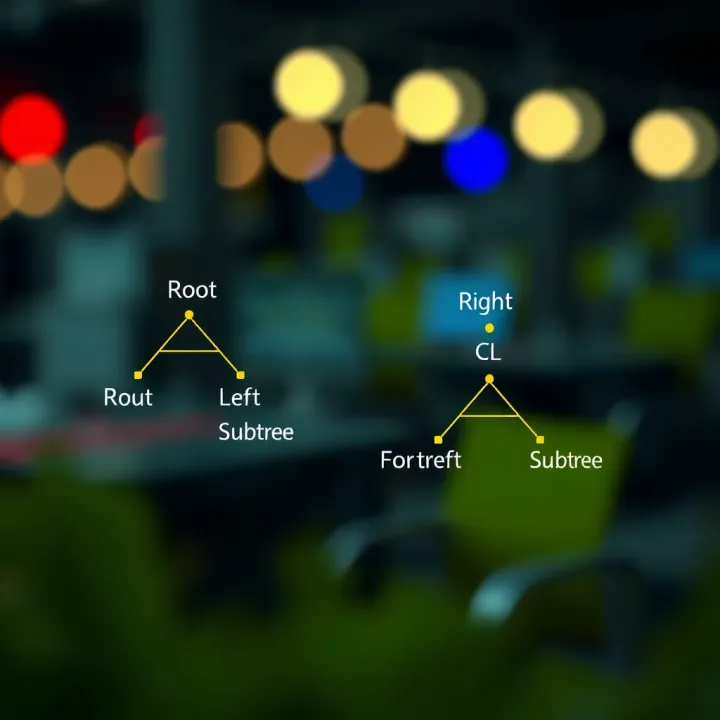
Preorder Traversal: Visit the root node first, then traverse the left subtree, followed by the right subtree.
Inorder Traversal: Traverse the left subtree first, visit the root node, then traverse the right subtree.
Postorder Traversal: Traverse the left subtree, then the right subtree, and visit the root node last.
Each method serves different purposes. For example, inorder traversal is especially useful when binary search trees (BST) come into play, producing sorted output. Preorder helps in copying the tree structure, while postorder is often used in deleting nodes or evaluating expression trees.
Understanding these traversal patterns allows you to extract meaningful data systematically, which is vital when managing heaps of data flows in trading algorithms or analysing hierarchical financial models.
Consider a simple binary tree:
plaintext
10
/
5 15
/ \
3 7 20
- Preorder: 10, 5, 3, 7, 15, 20
- Inorder: 3, 5, 7, 10, 15, 20
- Postorder: 3, 7, 5, 20, 15, 10

These traversal orders can be implemented using either recursion or iteration. Iterative approaches often use stacks for managing the nodes—this becomes important in environments with limited stack memory or when optimising for performance in high-frequency trading systems.

In the next sections, we'll break down these methods step-by-step with code snippets relevant to common programming languages used in Pakistan's tech ecosystem such as Python and C++, along with real-world use cases that show their impact in financial analytics and data processing.

## Preface to Binary Tree Traversal

Binary tree traversal forms the backbone of many computer science algorithms and applications. For traders and financial analysts dealing with large datasets, understanding how to navigate a binary tree efficiently is key. Traversal techniques enable you to access all nodes of a binary tree, allowing operations like searching, sorting, and data manipulation with precision. In practical terms, the right traversal method can improve the speed and accuracy of software that underpins stock analysis tools or crypto portfolio managers.

### What is a Binary Tree?

A binary tree is a data structure where each node has at most two children, commonly called left and right child. Imagine it similar to a decision tree you might use in trading—each choice leads to two possible outcomes. For example, a binary tree can represent price movements, where each node can indicate a price point and its immediate higher or lower value. This hierarchical setup allows quick access and organisation of complex datasets.

### Why Traverse a Binary Tree?

Traversing a binary tree means visiting all nodes in a systematic way. This process is crucial because it helps in extracting or processing data stored in the tree. For example, retrieving stock prices in chronological order or calculating cumulative portfolio returns requires traversing the tree with attention to the sequence. Without traversal, you'll struggle to perform meaningful operations on tree-based data structures. It’s the first step in solving problems like searching for a specific value or updating nodes in algorithms.

### Types of [Binary](/articles/understanding-binary-relations-examples/) Tree Traversal

There are three main methods to traverse a binary tree, each serving different needs:

- **Preorder traversal**: Visit the root node first, then the left subtree, followed by the right subtree. Useful for copying trees or expression evaluations where parent nodes matter before children.

- **Inorder traversal**: Visit the left subtree, root node, then right subtree. This method retrieves nodes in a sorted order for [binary search](/articles/understanding-binary-search-through-examples/) trees, valuable for processing ordered financial data.

- **Postorder traversal**: Visit the left subtree, right subtree, then the root node. This comes handy when deleting or freeing nodes or when you need to evaluate expression trees.

> Understanding these traversal methods is essential for anyone working with hierarchical data, be it in software development, algorithm design, or financial data management.

Each type brings a different approach to handling data, and choosing the right one depends on your specific application in trading algorithms or portfolio analysis tools.

## Preorder Traversal Explained with an Example

Preorder traversal is a primary method used to visit each node in a binary tree. It follows the sequence: process the current node, then traverse the left subtree, and finally the right subtree. This approach is especially useful when you want to duplicate the tree or evaluate prefix expressions. For traders and analysts dealing with algorithmic data structures, understanding preorder traversal helps in designing efficient search and retrieval mechanisms.

### How Preorder Traversal Works

Preorder traversal begins at the root node and immediately processes it, which means reading or handling the data stored in that node first. After processing the root, it moves recursively to the left child node and repeats the same pattern. Once the left subtree is fully traversed, it proceeds to the right child subtree. This method ensures that parent nodes are always dealt with before their children, reflecting a top-down approach.

This order is relevant when the context requires the parent data to be used before the child data, such as compiling expressions or configuring hierarchical data.

### Step-by-Step Preorder Traversal Example

Consider a binary tree with the following structure:


        15
       /  \
     10    20
    /  \     \
   8   12    25
The preorder traversal steps will be:
Start at root: visit 15
Move left: visit 10
Move left from 10: visit 8 (no children, backtrack)
Move right from 10: visit 12 (no children, backtrack)
Back to root, move right: visit 20
Move right from 20: visit 25 (no children)
The preorder sequence becomes: 15, 10, 8, 12, 20, 25.
Remember, preorder traversal is useful when the parent node must be handled before the child nodes, making it practical for tasks like copying tree structure or expression evaluation.
For developers involved in financial modelling or algorithmic stock analysis, mastering this traversal technique can improve data representation, particularly when working with expression trees or hierarchical decision-making systems. The preorder method provides a clear way to traverse and process tree data in the order it was constructed or logically prioritised.
Understanding how preorder traversal works with an actual example clears up common confusions and highlights its applicability in coding tasks and algorithm design.
Inorder traversal holds a special place in binary tree operations, especially when it comes to producing sorted output from binary search trees (BSTs). For traders and analysts working with decision trees or hierarchical data, understanding this traversal method allows for deeper insight into value sequences and structured data interpretation. This is because inorder traversal visits nodes in a left-root-right pattern, naturally reflecting ascending order for BSTs.
Inorder traversal follows a clear sequence. First, it moves entirely down the left subtree, visiting all nodes there before the parent node. Then, it processes the parent node itself. Lastly, it traverses the right subtree, applying the same rules recursively. This method ensures that, if the binary tree represents sorted data like price points or timestamps, the output respects that order.
To put it simply:
Visit left child (recursively)
Visit current node
Visit right child (recursively)
This sequence might look straightforward, but it plays a vital role in many algorithms where ordered data extraction is needed without rearranging the tree.
Consider a binary search tree representing stock prices recorded at different times:
plaintext
50
/
30 70
/ /
20 60 80
Applying inorder traversal here would follow:

1. Start at the root (50), first traverse the left subtree.
2. In the left subtree, visit 20 (leftmost), then 30.
3. Return to root node, process 50.
4. Move to right subtree, starting at 70.
5. First visit left child (60), then 70.
6. Finally, visit 80.

The result will be the sorted sequence: **20, 30, 50, 60, 70, 80**.

This sequence can represent a sorted list of transaction values, time-stamped price points, or other hierarchical financial data. Traders analysing such sequences benefit from easily accessing sorted information without extra sorting overhead.

> Inorder traversal is particularly useful because it outputs data in a natural, sorted order for binary search trees, making it ideal for algorithms that depend on ordered data retrieval.

Knowing the inorder traversal process helps financial analysts and developers optimise data handling applications, especially those involving hierarchical datasets or decision-making trees. The simplicity of following left-root-right also makes it easier to implement and debug compared to some other traversal methods.

## Understanding Postorder Traversal Through Example

Postorder traversal is an essential method for visiting all nodes in a binary tree where you first explore the left subtree, then the right subtree, and finally the node itself. This approach is particularly useful in scenarios such as deleting trees, evaluating expression trees, or handling dependencies in computations. Grasping postorder traversal helps you understand how tasks with prerequisites can be systematically managed.

### How Postorder Traversal Operates

In postorder traversal, the process follows a strict pattern: left child, right child, then the parent node. This means the traversal waits until it has visited all descendants of a node before processing the node itself. In practical terms, it’s like clearing out all books from subsidiary shelves before finally arranging the main shelf.

This method suits cases where children or sub-components must be handled before their container or parent component. For example, in file system operations, deleting files and subfolders before deleting a folder is a real-life illustration of postorder logic.

### Example Demonstrating Postorder Traversal

Consider a binary tree where the root node is 'A', with a left child 'B' and right child 'C'. Further, 'B' has children 'D' (left) and 'E' (right), while 'C' has 'F' (left) and 'G' (right). The traversal visits in this order:

1. Left subtree (B):
   - Visit 'D' (leaf node, so processed immediately)
   - Visit 'E'
   - Process 'B' after its children
2. Right subtree (C):
   - Visit 'F'
   - Visit 'G'
   - Process 'C'
3. Finally, process root 'A'

This results in the sequence: D, E, B, F, G, C, A.

Such a sequence ensures that any operation dependent on child nodes is completed before the parent node is touched. For financial data systems or algorithm implementations where calculations depend on sub-results, this traversal is particularly handy.

> *In essence, postorder traversal is your go-to when the order of operations matters, allowing for safe and logical processing from the bottom up.*

By understanding postorder traversal with such concrete examples, traders, financial analysts, and crypto enthusiasts can appreciate how this method structures tasks that require prerequisite completion. Whether coding portfolio risk evaluation or managing transactional dependencies, this traversal method offers a reliable backbone for systematic organisation.


## Iterative Methods for Binary Tree Traversal

Iterative methods for binary tree traversal offer practical alternatives to their recursive counterparts, especially when system resources are limited. Unlike recursion, which uses the program stack internally, iterative techniques explicitly manage a stack data structure. This control over the traversal process helps prevent potential stack overflow issues in large trees, a real concern when processing massive financial datasets or real-time trading information.

### Using Stacks for Traversal

Stacks are the backbone of iterative binary tree traversal. For preorder and inorder traversals, a stack keeps track of nodes yet to be visited or processed. For example, in preorder traversal, the stack initially holds the root. Each time a node is popped, its right child is pushed first, then the left child. This order ensures the left subtree is processed before the right, replicating the preorder principle.

Consider a trading algorithm scanning a decision tree for market conditions. Using an iterative stack approach here reduces function call overhead, resulting in faster traversal and quicker decision-making—key when milliseconds matter.

For postorder traversal, iterative methods are trickier. One common technique uses two stacks or modifies one stack with markers to track whether a node’s children have been processed. Though more complex, these methods avoid the deep recursive calls that can cause program crashes during large-scale data analysis.

### Comparing Recursive and Iterative Approaches

Recursive traversal code is elegant and easier to write, making it popular for learning and small projects. However, it relies on the call stack, which can be a limiting factor when data grows. Iterative methods handle larger trees without risking stack overflow and provide more predictable memory usage, a significant benefit in robust trading platforms.

That said, iterative traversal can be more complex to implement and harder to understand at first. Traders and analysts working with tree-based data structures should balance ease of maintenance with performance needs. For example, recursive traversal might suffice for small-order book trees, while iterative methods better serve extensive risk modelling trees involving thousands of nodes.

> Effective binary tree traversal is not just an academic exercise—it directly influences the efficiency of algorithms driving trading and investment decisions in today’s fast-moving markets.

In summary, iterative approaches using stacks offer a resource-friendly, controlled way to traverse binary trees. While recursion remains useful for straightforward scenarios, iterative methods become essential for processing large trees reliably, making them a vital tool for anyone managing complex financial data structures.

## Practical Applications of Binary Tree Traversal

Binary tree traversal isn't just a theoretical concept; it plays a solid role in real-world computing systems. Knowing how to walk through a tree effectively helps manage and access data quickly, which is critical in finance and tech today. Understanding traversals gives you a clear edge, whether that’s optimising data searches or parsing complex expressions.

### Use in Data Organisation and Searching

Binary tree traversal techniques often underpin how large data structures get organised and searched. For example, in binary search trees (BSTs), inorder traversal lists data in sorted order—very handy for financial records or stock prices sorted by date or value. If you want to quickly find a price point or index, traversing the tree in the correct order speeds things up dramatically.

Besides BSTs, heaps use traversal methods to maintain the priority of tasks or processes. Imagine a crypto trading bot that prioritises orders based on urgency—traversal ensures the highest priority tasks get attention first. Traversals also feature in database indexing, where trees like B-trees store and retrieve entries efficiently. When you browse through e-commerce marketplaces like Daraz or check stock prices on PSX, these underlying systems may use tree traversal to fetch your data fast.

> Traversing binary trees ensures you access and sort data efficiently, which means quicker results and better performance for trading platforms and financial analyses.

### Role in Expression Trees and Compilers

Expression trees use binary tree traversal to evaluate mathematical or logical expressions, essential in programming languages and compilers. For instance, preorder traversal helps compilers translate code into machine instructions by starting at the operation before processing its operands. This helps convert complex formulas used in financial modelling or risk calculations into executable steps.

Postorder traversal also plays a role here; it evaluates expressions by handling operands first and then the operation itself. This method is common in calculators or software that needs to compute nested expressions securely and efficiently.

In the scenario of algorithmic trading, expression trees might handle the parsing of trading strategies coded as logical conditions. Traversals make sure these instructions run correctly, which can be the difference between a profit and a loss.

In short, binary tree traversal isn’t just an academic exercise. It directly impacts how your favourite financial apps work, how trading algorithms process data, and how complex computations are handled under the hood. Knowing these practical applications adds depth to your understanding of programming and data structures valuable in today’s tech-driven market.Explore the basics of binary relations 🔗 with real-world examples. Learn key properties, types, and applications in math and computer science!

Explore how binary fission works in simple organisms 🧫, with examples and biological importance explained clearly for biology enthusiasts in Pakistan.

🔍 Understand binary search through easy examples! Learn how it works on sorted data, see step-by-step guides, and apply it smoothly in programming tasks.

Explore binary operations 🔄 in detail—definitions, key properties, and practical examples in math and computer science for a clear, hands-on understanding.
Based on 13 reviews